Houston precipitation
This case estimates severity and extremal clustering in daily precipitation relative to its recent level. It uses EWMA-normalized, full-calendar observations, including dry-day zeros.
Record and normalization
The source is NOAA GHCN-Daily station USW00012918, Houston William P. Hobby
Airport. Daily PRCP is converted from tenths of a millimetre to millimetres;
missing values and nonblank quality flags are excluded. The full daily calendar
is retained while identifying the longest uninterrupted valid run, with the
latest run selected on a length tie. No months are concatenated across seasons.
After 30 warmup days, the fitted record is 1990-03-03–2022-05-30, with 11,777 consecutive days. The archive cutoff remains 2025-12-31; later gaps prevent the chosen continuous run from extending to that cutoff. This sample differs from the former June–November illustration.
X_t = daily precipitation in mm, including genuine zeros
Y_t = X_t / m_t
m_t = ρ m_(t−1) + (1−ρ) X_(t−1),  ρ = 2^(−1/180)
The initial denominator is the mean of the preceding 30 days. Y_t is a
dimensionless precipitation-to-past-level ratio, not rainfall in millimetres
or a standardized anomaly. Only earlier observations enter the denominator.
See the shared normalization definitions.
EVI, EI, and design-life levels
| Quantity | Estimate | Conditional 95% CI |
|---|---|---|
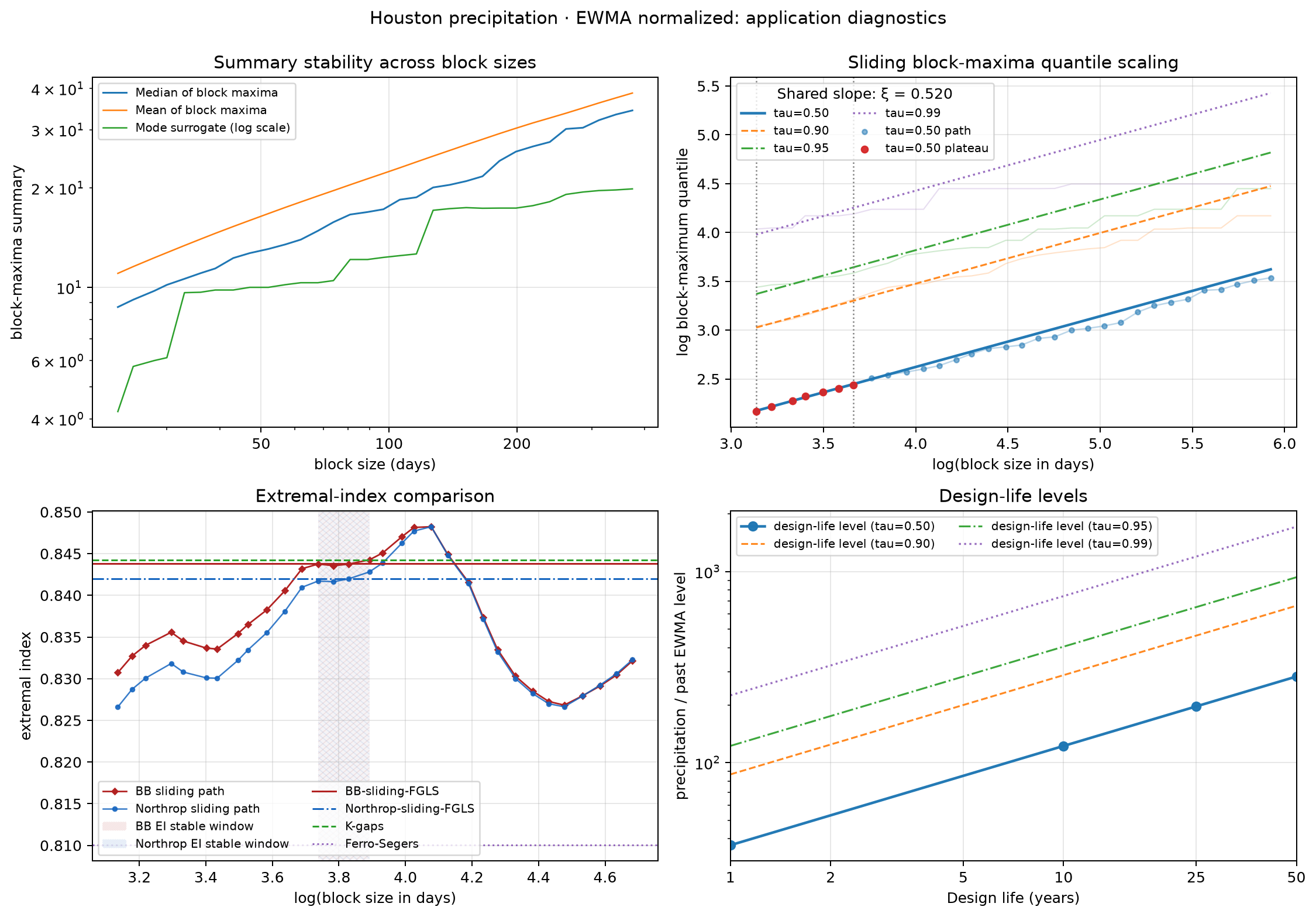
| EVI ξ | 0.520 | [0.380, 0.660] |
| BB-sliding-FGLS EI θ | 0.844 | [0.793, 0.898] |
| Northrop-sliding-FGLS EI θ | 0.842 | [0.790, 0.897] |
Download numerical results and preparation settings (JSON).
The selected EVI window is 23–39 days. The EI describes clustering of large relative rainfall observations; it is not the persistence of all wet days. Design-life curves use 365.25 observations per year and describe the maximum normalized daily rainfall over the horizon, rather than accumulated rainfall.
The nominal CIs use the common FGLS/Wald settings in the case overview. They do not include uncertainty from estimating the EWMA level or selecting the record and fit window. EWMA does not establish removal of rainfall seasonality or long-term change. A future millimetre-scale level would additionally require a model for the future denominator.
Reproduce
PYTHONPATH=scripts uv run python -m application.docs_cases --keys houston_hobby_precipitation
Preparation uses the tracked normalization code and the archived GHCN station input.