GOES soft X-rays
This case estimates block-maximum scaling in EWMA-normalized hourly soft X-ray irradiance. It retains the hourly calendar and uses complete sliding windows across the available history. It reports OLS EVI point estimates and design-life curves only: no EI and no CI.
Source and hourly aggregation
The source is NOAA's science-quality GOES XRS-B 0.1–0.8 nm one-minute mean irradiance archive. The reconstructed calendar covers 1995-01-03–2025-12-31. It is a retrospective science product, not the finest native sensor sampling and not total solar irradiance.
The snapshot builder follows the documented satellite priority schedule, using secondary observations for gaps and treating GOES-13 as fallback. It retains finite positive unmasked flux, excludes nonzero flux quality flags and unresolved saturation, and requires valid electron correction where provided. It neither selects the largest reading across satellites nor adds an empirical rescaling.
For each UTC hour, take the maximum of the accepted minute means only if at least 57 of 60 minutes are valid and no unresolved saturation remains. Otherwise retain a missing hour. This is a maximum of minute averages, not an instantaneous irradiance peak; even three missing minutes could conceal a peak.
Normalize without compressing gaps
For each uninterrupted qualified hourly run:
X_t = hourly maximum of qualified minute-mean irradiance
Y_t = X_t / m_t
m_t = ρ m_(t−1) + (1−ρ) X_(t−1),  ρ = 2^(−1/4320)
Initialize with the mean of its first 720 hours (30 days), then analyze from
the next hour. The half-life is 4,320 hours (180 days). Restart after every
gap. Runs no longer than the warmup contribute no normalized observations.
Missing and warmup positions remain missing; no interpolation or time compression
is performed. Y_t is a dimensionless irradiance-to-past-level ratio, not W/m².
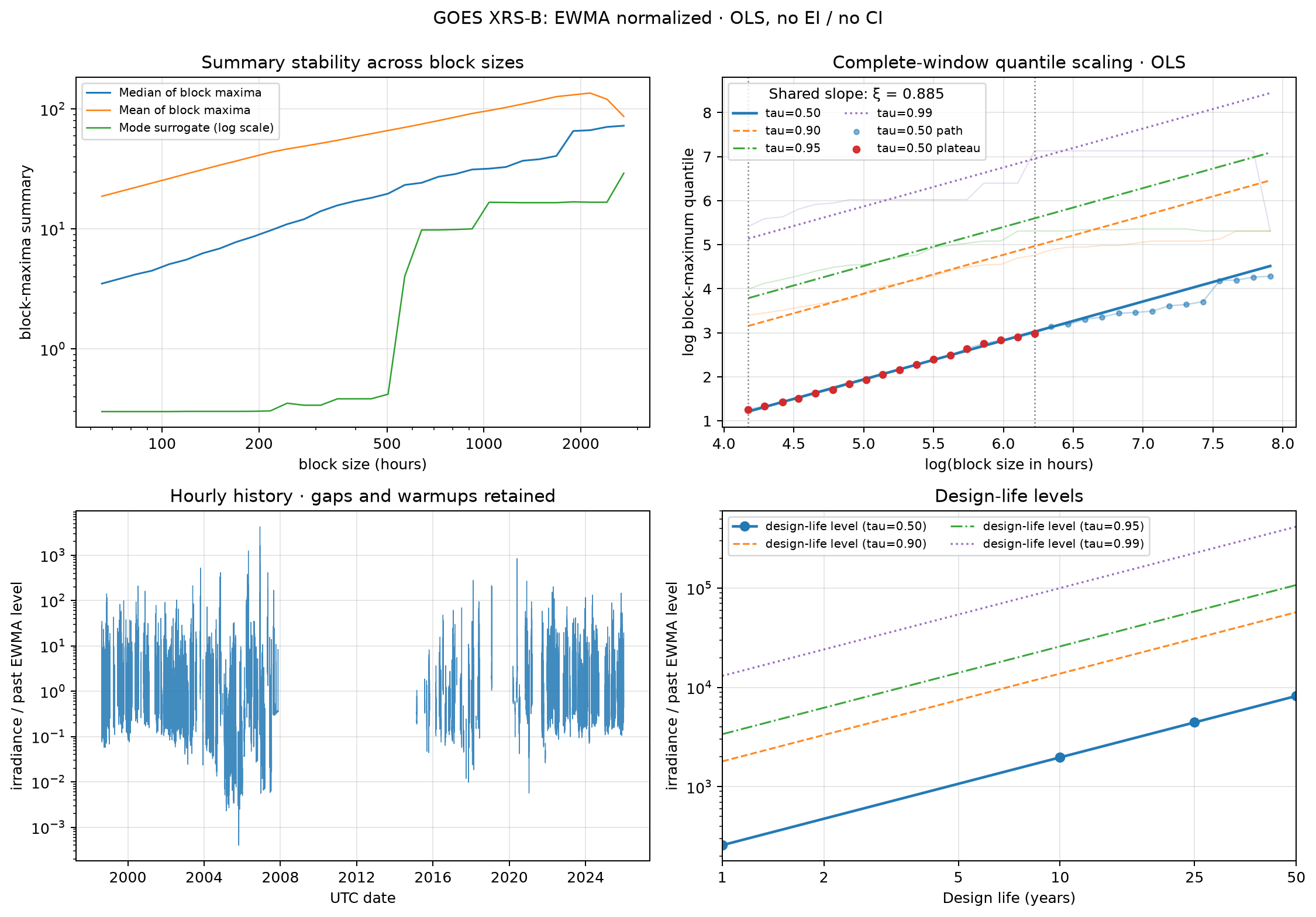
The 271,704-hour calendar contains 266,000 qualified hours before normalization. Restarted warmups leave 94,226 normalized hours across 64 runs, spanning 1998-08-21 19:00–2025-12-31 23:00 UTC. These endpoints do not imply complete coverage between them. The displayed time series uses these same eligible hours.
EVI point diagnostic
The fitted EVI is 0.885, with selected block sizes 65–504 hours.
The grid is based on the complete calendar length, including missing positions;
only fully observed windows contribute to a block summary. Consequently the
N/17 cap does not guarantee 17 usable disjoint blocks after missingness.
Download numerical results and preparation settings (JSON).
Complete-window counts are provided in the JSON record. Overlapping windows are dependent and are not independent replications. EWMA restarts and complete-window selection change the contribution of different years and solar-cycle phases at each block size; missingness need not be random.
The existing FGLS bootstrap has not been validated for this gapped construction. The API's OLS HC0 interval is therefore suppressed in the published results. Design-life curves use 8,766 hours per year and express maxima of the relative series under a stationary working model. They do not convert to future W/m² without modeling future scales. Solar cycles, residual calibration differences, and instrument limits remain relevant after normalization.
Reproduce
Using the local quality-screened hourly input and its hash-bearing JSON:
PYTHONPATH=scripts uv run python -m application.docs_cases --keys goes
To rebuild that input from NOAA files, the optional downloader requires netCDF4;
it is not a package runtime dependency. Downloading the historical archive can
be substantial, so this step is separate from the normal application workflow:
uv run --with netCDF4 python scripts/data_prep/goes_snapshot.py
uv run python scripts/data_prep/goes_hourly.py
goes_snapshot.py --offline reuses the previously saved listings and NetCDF files.
Inputs remain local under data/raw/goes and data/processed/inputs.
The scripts record source URLs, quality rules, satellite priorities, and SHA-256
hashes. Available archive versions may change, so a new retrieval need not recreate
the frozen result exactly.
Sources: NOAA legacy science archive and GOES-R archive.